Road Signs
Learn the key concepts before practicing exam questions.
In this topic you'll learn:
- How to read a sign's shape and colour before you can read its words
- The regulatory signs you must obey, and the warning signs that tell you what's ahead
- Default speed limits, and the rules for school and playground zones
- Construction zones and other special signs
Sign questions make up a large part of the knowledge test. Learn the shapes and colours first, and many signs become easy to guess.
| Shape / colour | Meaning |
|---|---|
| Red octagon | Stop |
| Red and white upside-down triangle | Yield |
| Red circle with slash on white | That action is not allowed |
| Green circle on white | That action is allowed |
| White rectangle, black text | Regulation you must obey (e.g. speed limit) |
| Yellow diamond | Warning of a hazard ahead |
| Orange diamond | Construction zone |
| Fluorescent yellow-green pentagon | School zone or area |
| Black square, white symbol | Lane control: where each lane may go |
| Green rectangle | Directions and distances |
| Blue square | Services: fuel, food, lodging |
Driver's Guide pp. 25–26
- Stop: come to a complete stop and go only when it's safe.
- Yield: let traffic that is not facing the sign, and all pedestrians, go first.
- Do not enter (red circle, white bar) and Wrong way: you are about to drive against traffic.
- Railway crossing (white X with red border): yield to trains.
- Do not stop on tracks.
- One way (arrow): travel only in the direction of the arrow.
- Two-way traffic: traffic goes both directions ahead.
- Divider ahead, keep right.
Driver's Guide pp. 26–27
Green circle = allowed. Examples: turn left only, turn right only, straight only, passing permitted, dangerous goods route, trucks, bicycles, snowmobiles.
Red circle with slash = not allowed. Examples: no left turn, no right turn, no U-turn, do not pass, do not pass bicycles, no pedestrians, no trucks, no bicycles, no dangerous goods.
Parking signs: a red circle over a P means no parking. A red circle over a stop sign means no stopping. An arrow shows which side of the sign the rule applies to, and times and days show when it applies.
Driver's Guide pp. 29–30
White arrows on a black square show where each lane must go: straight only, left turn only, straight or right, and so on.
- Dual turn signs mean two lanes may turn together. Stay in your lane during and after the turn.
- Reserved lane signs show a white diamond plus the vehicles allowed (buses, taxis, bicycles). Some reserved lanes apply at all times; others show the hours and days when they apply.
Driver's Guide p. 28
A speed limit is the maximum speed when conditions are ideal. Driving at a speed that is unsafe for the conditions is illegal, even if you're under the limit.
Unless a sign says otherwise:
| Road | Limit |
|---|---|
| Provincial highway outside an urban area | 100 km/h |
| Provincial highway inside a city | 80 km/h |
| Other roads outside an urban area | 80 km/h |
| Roads inside an urban area | 50 km/h |
A provincial highway has a numbered route marker (1, 2, or 3 digits). Municipalities may set different limits, so always follow the posted sign.
Driver's Guide p. 27
| School zone | Playground zone | |
|---|---|---|
| Sign | School sign with a speed tab | Playground sign with a speed tab |
| Speed | 30 km/h unless posted | 30 km/h unless posted |
| When | School days: 8:00–9:30 a.m., 11:30 a.m.–1:30 p.m., 3:00–4:30 p.m. | Every day: 8:30 a.m. to 1 hour after sunset |
| Passing | Not allowed while in effect | Not allowed while in effect |
- The 30 km/h limit applies in both urban and rural zones.
- A zone ends at a sign showing a higher speed or "end" of the zone.
- A school or playground sign without a speed tab marks an area, not a zone. There is no special speed limit, but drive with extra caution.
- Towns may set different hours. If so, they are posted under the sign.
Driver's Guide pp. 30–32
Yellow diamonds warn you before you reach a hazard, so you have time to react. They fall into groups:
- Regulation ahead: stop ahead, yield ahead, traffic signals ahead, school bus stop ahead
- Curves: sharp turn, curve, winding road. A yellow speed tab underneath is the recommended speed in ideal conditions.
- Crossings: pedestrians, school crosswalk (yellow-green), animals, bicycles, snowmobiles
- Intersections: hidden road, T and Y intersections, railway crossing, roundabout, and dead end (yellow-and-black checkerboard)
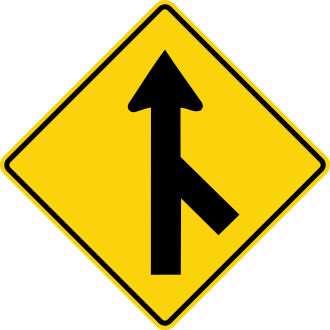
- Roads joining: merging traffic (roads join and share the lane) vs free flow (an added lane, no merge needed)
- Narrowing: road narrows, lane ends, divided highway begins or ends
- Road conditions: hill, bump, pavement ends, slippery when wet, bridge ices, rumble strips, falling rock
- Hazard markers (diagonal stripes) show an object beside the road. Chevrons show a sharp bend.
Driver's Guide pp. 32–35
Construction signs are orange.
- The construction zone speed limit applies at all times, even when no one is working. Bumps, fresh oil, and loose gravel can still be there.
- When workers are present, speeding fines are doubled.
- Obey the flag person's signals, and be ready to slow down or stop.
Common signs: people working, flag person ahead, survey crew, uneven pavement, detour, and end of construction.
Driver's Guide pp. 37, 86
- Green guide signs give directions and distances. Route markers show highway numbers (Trans-Canada, Yellowhead, provincial highways).
- Blue service signs point to fuel, food, lodging, campgrounds, and EV charging. Green service signs point to the hospital (H), airport, and parking.
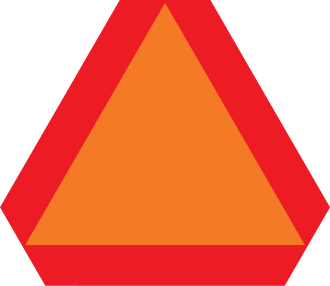
- Slow moving vehicle (orange triangle, red border): shown on the back of vehicles that travel under 40 km/h, such as tractors and construction equipment. Be ready to slow down.
- Wide load: an oversized load. Pass with care.
- Disabled parking: only vehicles with a valid placard or licence plate may park or stop there.
Driver's Guide pp. 32, 36–37
| What | Number |
|---|---|
| School and playground zone speed | 30 km/h (unless posted) |
| School zone hours (school days) | 8:00–9:30, 11:30–1:30, 3:00–4:30 |
| Playground zone hours (every day) | 8:30 a.m. to 1 hour after sunset |
| Provincial highway outside an urban area | 100 km/h |
| Provincial highway in a city / other rural roads | 80 km/h |
| Urban roads | 50 km/h |
| Slow moving vehicle sign | vehicles under 40 km/h |
| Construction zone fines | doubled when workers are present |
- School zone vs playground zone: school zones apply on school days at set times. Playground zones apply every day until an hour after sunset.
- Zone vs area: a speed tab under the sign makes it a zone with a 30 km/h limit. No tab means an area: use caution, but there is no special limit.
- Green circle vs red slash: green means allowed, red slash means not allowed.
- Merge vs free flow: at a merge, two roads join and drivers must cooperate. Free flow adds a lane, so nobody has to merge.
- Yellow speed tab vs white speed limit: yellow is a recommended speed for a curve. White is the legal limit.
- Construction speed limits apply at all times. Workers being present only doubles the fine.